
I’m an early adopter of personal AI agents. Not in the tech bro kind of way, as I’m generally allergic to hype. But my memory is patchy and I have a deep disdain for admin, so having an agent really helps me with that.
I’ve always been bad at paperwork, forms and inboxes. But a year ago, I started talking to my computer, and felt a little more resourceful.
“Remember this for me.” → Remembered.
“Check that off my list.” → Checked.
“Send this note to Michael.” → Written and sent.
Forget superintelligence and AI extinction for a moment - that’s not where we are, and we don’t know where the story ends. Let’s focus on now.
What we have now is much simpler and appealing, almost boring:
A natural language interface for everything computers can do.
Agents are great at understanding intent and translating that into action. Instead of clicking through five screens to do something, I just... ask.
“Computer, enhance!” What a time to be alive.
It can be a great sounding board, too. For most of human history, thinking out loud required another person (or a rubber duck). Now it doesn’t. It’s just a very useful tool to learn new things and work out tricky issues. I’ve had a great time exploring this.
And then, a detour.
My dad died. That sucked, to be blunt. I became the person responsible for an estate - probate, banks, insurance paperwork on top of grief. Fuck. I am probably the wrong person for this job on the best of days, and these were not good days. So I leaned on the tools at hand. I told my agent what was going on and the issues I was dealing with. In return, it helped me structure the process, remember important details and get things done before they slipped my mind.
It didn’t take long before I realised what I’d done. I had shared that moment with Big AI™, and my struggles through this time are now recorded on a corporate server in America where it will stay for ~5 years as training data, material for advertising or whatever the owners of these companies see fit.
Do I want <any tech ceo> to have a file on how I handled my father’s death? No way! I don’t want anyone to have that. And if you’re being honest, you probably have your own version of that file sitting somewhere, out there in the cloud.
This worries me.
We thought social media had a privacy problem. At least social media is about what you share in public. Personal AI gets at our private thoughts: half-formed ideas, grief, worries, health etc. A growing number of us are telling our bots about these things. By the labs’ own numbers, we send them 50M+ sensitive personal messages every day1. We share willingly, because the tool is useful enough that talking to it is becoming just how we use computers.
Google’s insight two decades ago was that owning the entrypoint to the internet is the most powerful position in tech. Personal AI is that position again: a natural interface to every system you deal with daily. That’s why Big Tech is fighting over it, giving us cute, fuzzy agents and telling us not to worry about them running it for you in a cloud sandbox.
If we give Big Tech control of everything we think nearby a computer, we will give something away that no generation has done before.
We should think carefully about that.
Some people want the most capable agent money can buy. What I want is a tool that works, is safe, is private, and that doesn’t make me feel constantly fucking worried about what happens if I use it.
So we started working on Eigin. Be the change you want to see, right?
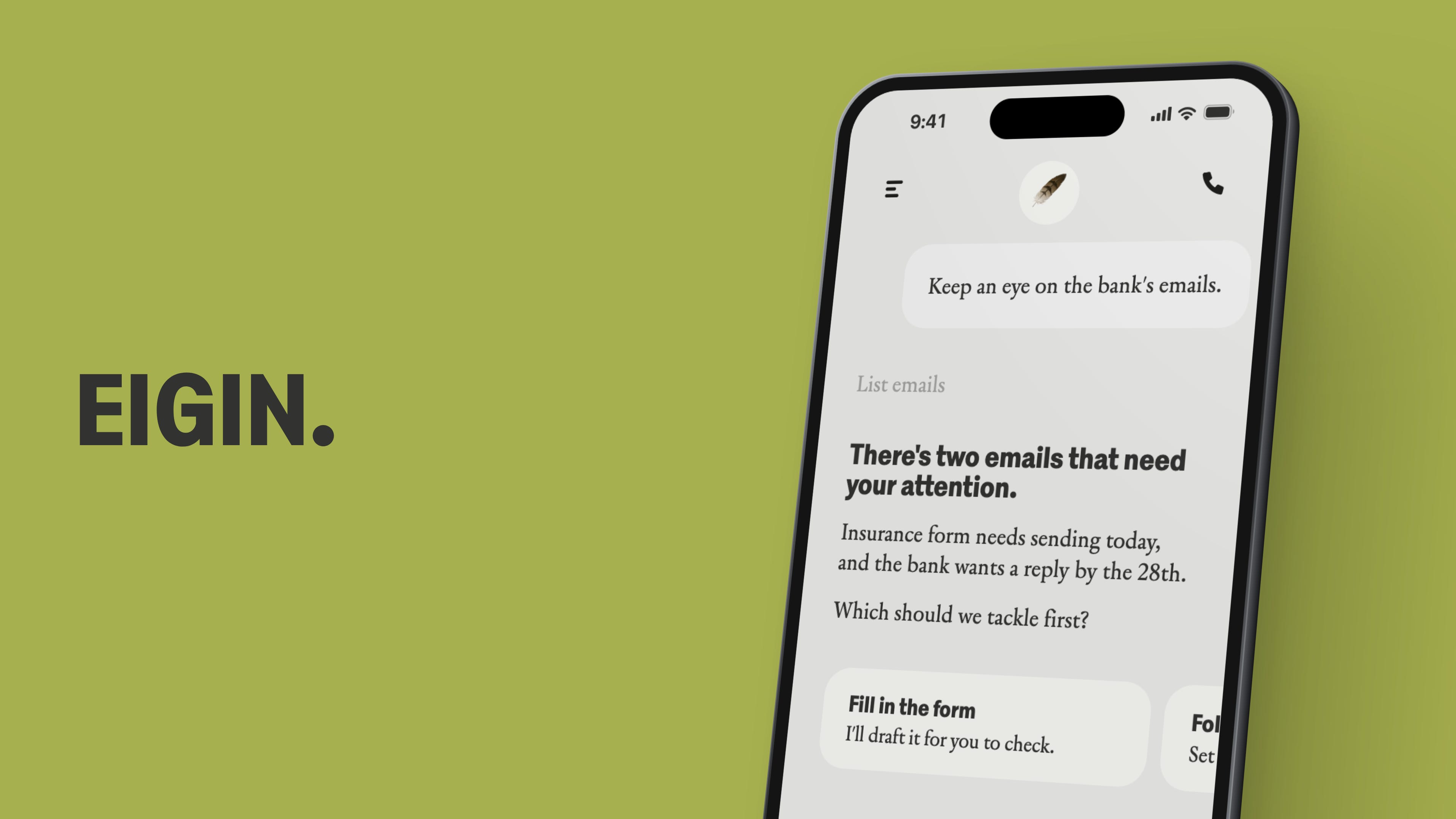
Eigin is a personal agent, basically. But we made some choices that run against the zeitgeist.
Safety first. It’s not an unsupervised open-ended agent in a sandbox, and it’s not “always on”. It has a closed set of tools, with permissions built into the execution path of each tool itself (instead of detected from the outside).
It’s private. The software is local-first, so chats and everything the agent knows about you stays on your own device. Use it offline with local models, if you like.
And it’s yours. You possess the agent, the data and the choice to connect any LLM and switch at any time. The source code is open, infrastructure and all.
If a handful of billionaires are going to compete to rent you a front door to your computer, there should also be a door you can own.
We spent the last 9 months working on Eigin. That’s about 200K lines of code and a framework for safe personal agents that works. We’re in open beta on iOS, now working on a cross-platform SDK that you can run anywhere (web next).
If any of this resonates, please reach out to me. You can find us at eigin.ai where you’ll also find the beta, roadmap and source code.
Let’s collaborate!
Together we can shape a future where personal AI belongs to us.
OpenAI, "How People Use ChatGPT” (2025): ~2.5B messages / day, 1.9% classified as “relationships and self-reflection.” OpenAI Signals v3 (2026): personal messages now 68% of all messages, though I think that’s based on different definition.